Purpose-built for rugby league — from Under 6 to Opens.
Junior rugby league and senior rugby league are two different games. Kickd is built for both — fairness and compliance for the little ones, a competitive analytics edge for the grades that count.
Which team do you coach?
Levels of logging
Learn one level at a time. Each one has its own tutorial.
Under 12s and younger run on level 1: scores, fair game time and the vests. Level 2, Set Completion, is the step waiting at Under 13, and it adds to what you already do, so nothing you learn is thrown away.
Game day basics
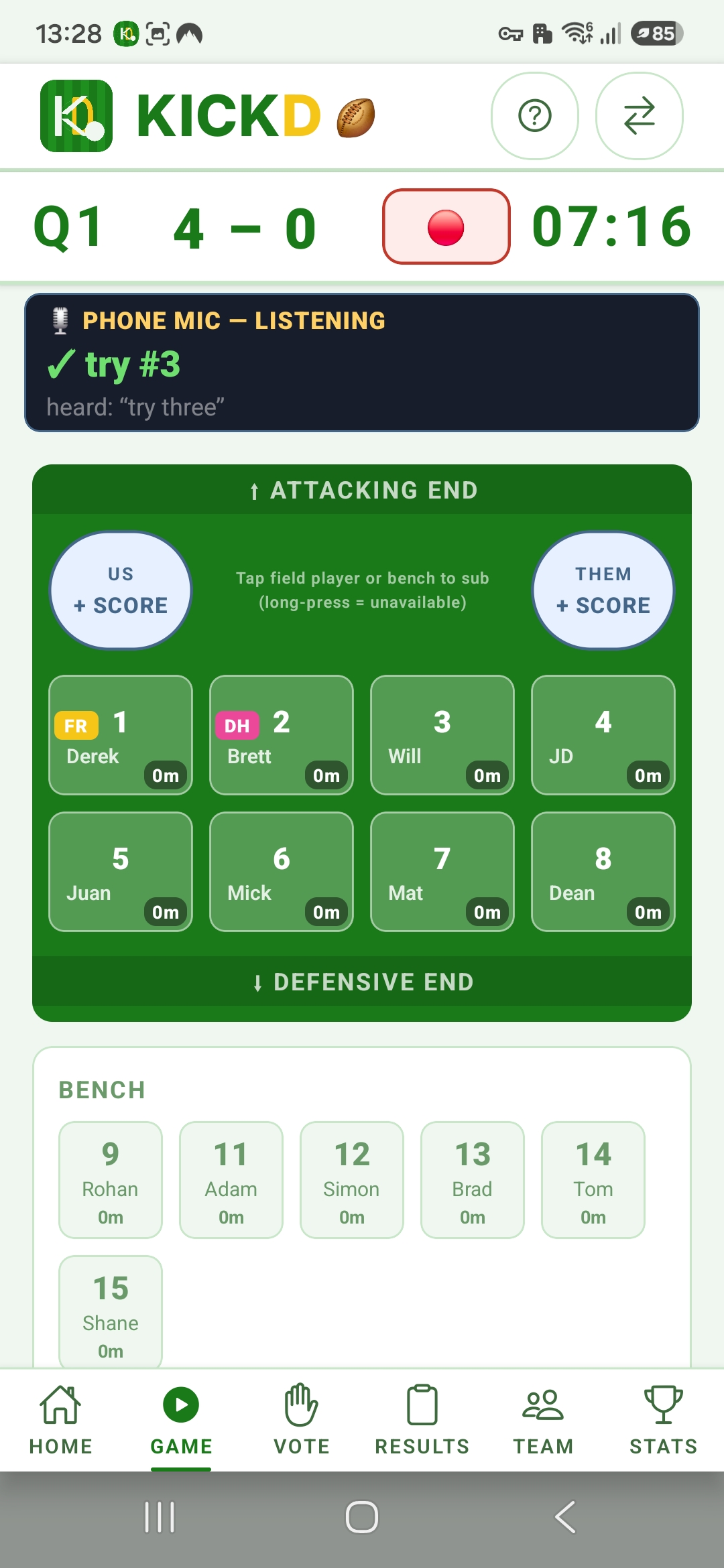
Who: Every coach. At U12 and under this is the whole job.You log: Scores, interchanges or rotations, and the FR and DH vests at U8 to U12.You get: Every player's minutes, the fairness score, Player of the Match and the parents' Players' Player vote.Plan: Team PassPhone, by tap. An Under 9s and an Under 12s game. Open on YouTubeSet Completion
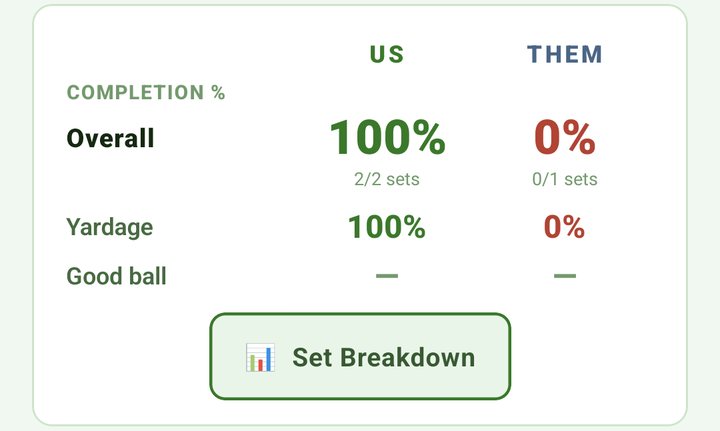
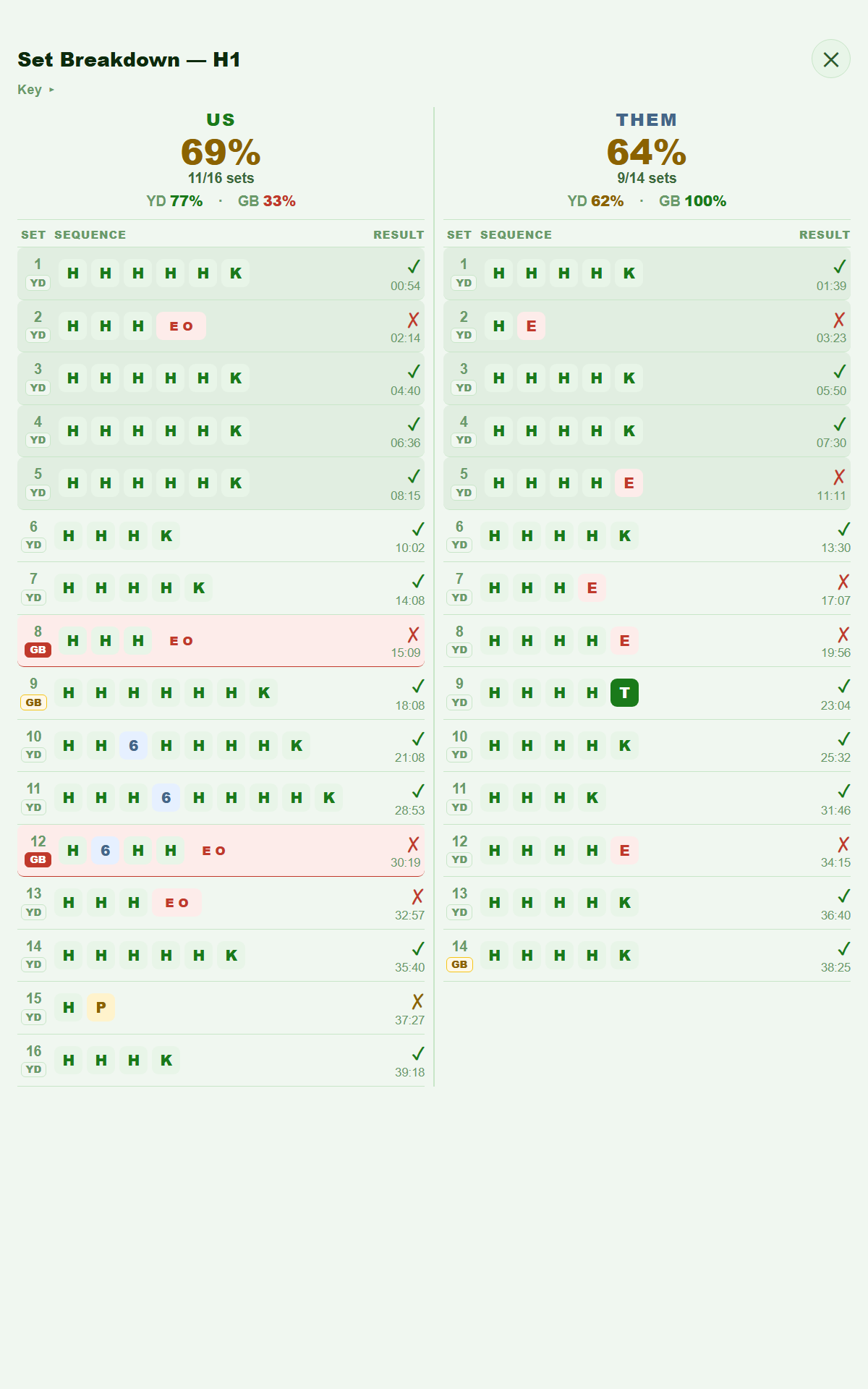
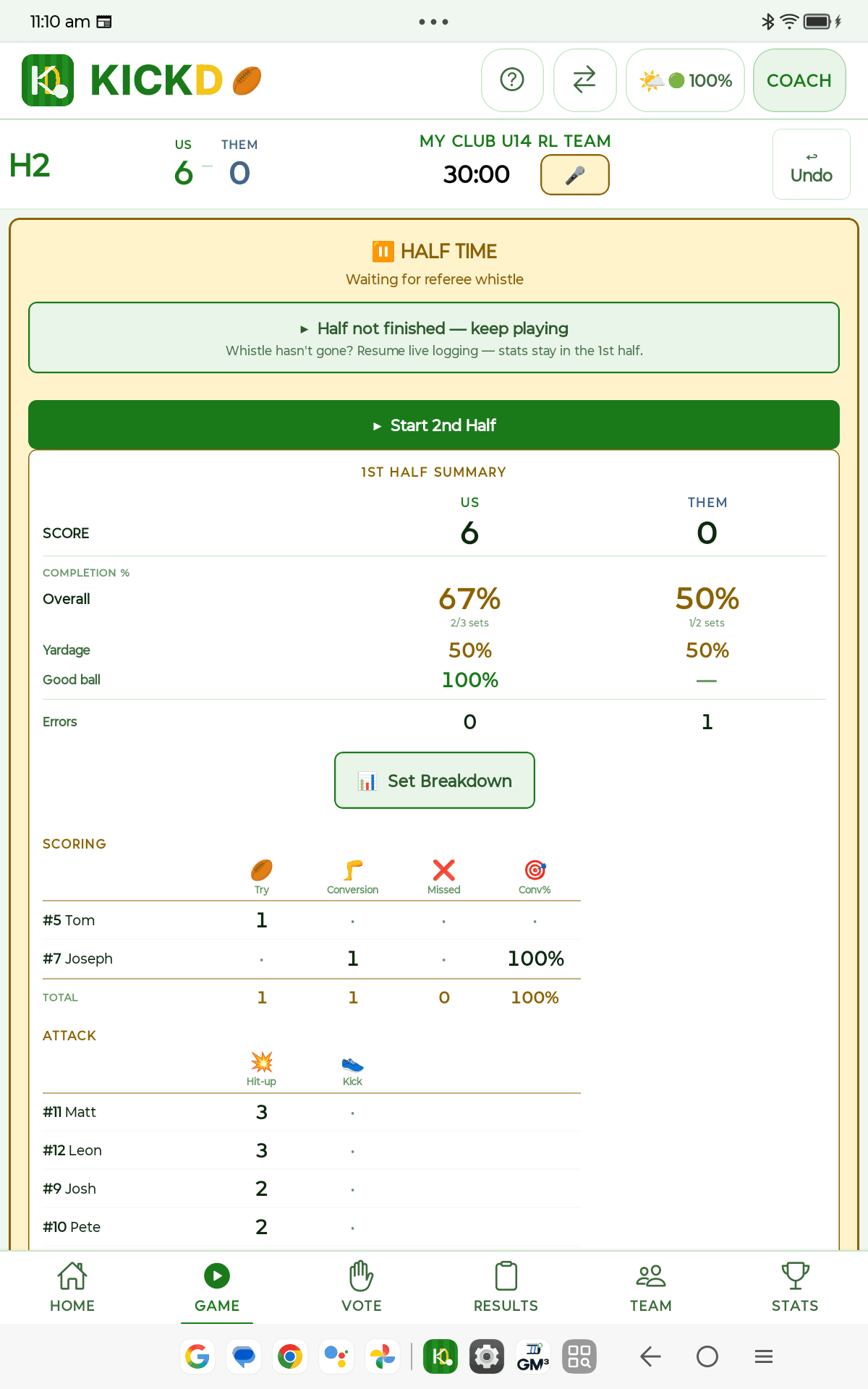
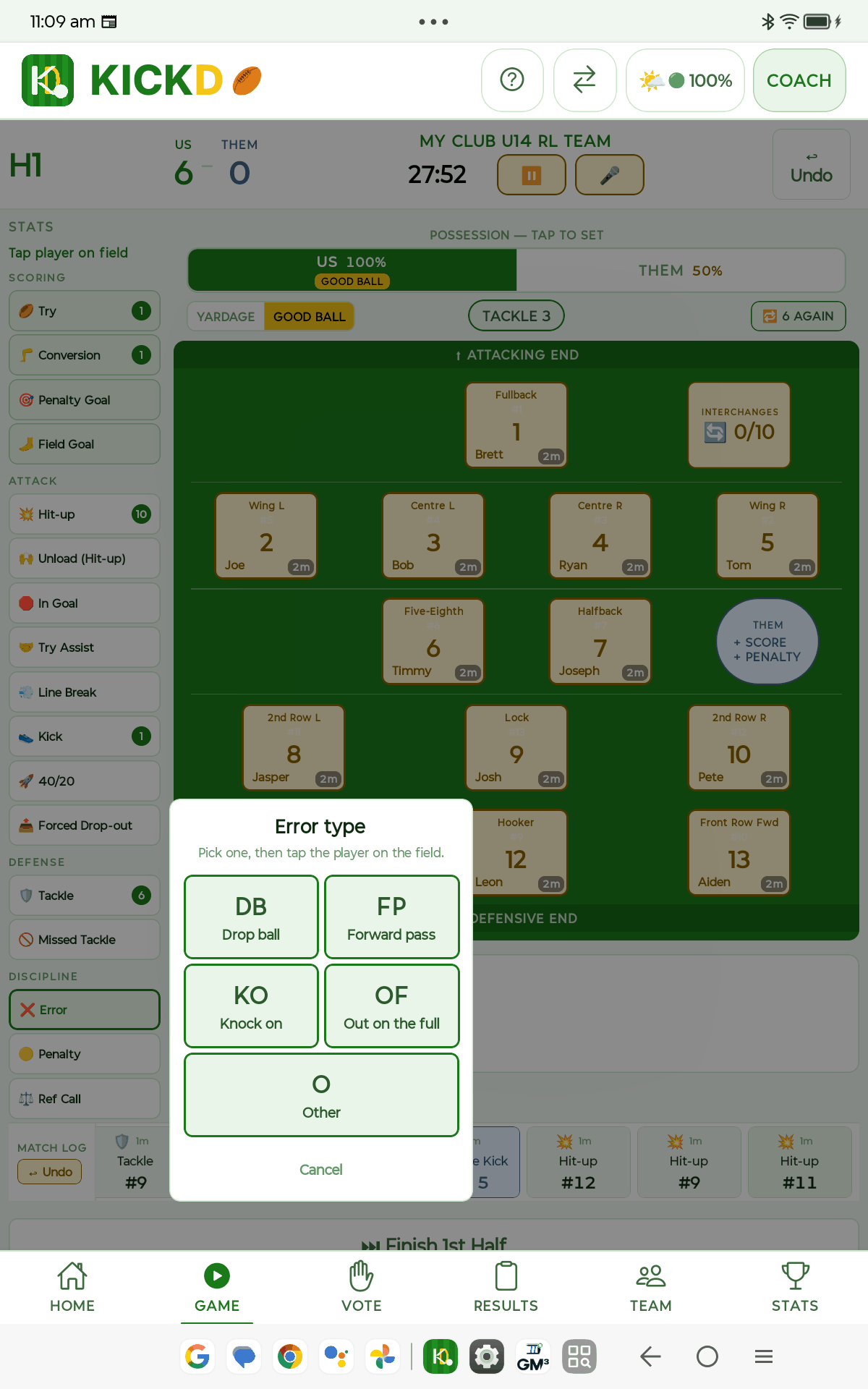
Who: Your team from Under 13. Under 10 to Under 12 teams with EXTENDED STATS switched on can use it now.You log: The basics, plus how each set ended, both teams: a score, kick, handover, error or penalty.You get: Completion % for both teams at half time and full time, and every set in the Set Breakdown.Plan: Team Stats. Your first 3 matches run at this level free.Phone, by voice, with the taps shown. Open on YouTubeWatch all three levels in order on YouTube →
You change level with one tap under LOGGING LEVEL on the TEAM tab, either way, at any time. After three games with every set logged, the results screen asks if you want Full logging. It never switches for you. Under 10 to Under 12 teams with EXTENDED STATS switched on can use levels 2 and 3 as well.
Every kid gets a fair go — and you stay compliant with the 2026 NRL Junior Laws, automatically.
Junior rugby league has changed. The 2026 National Junior Laws (U6–U12) brought in new rules around shared roles and fair participation. Kickd handles them for the coach — no notebook, no spreadsheet, no second-guessing — so every coach runs game day to the same standard, whatever their experience.
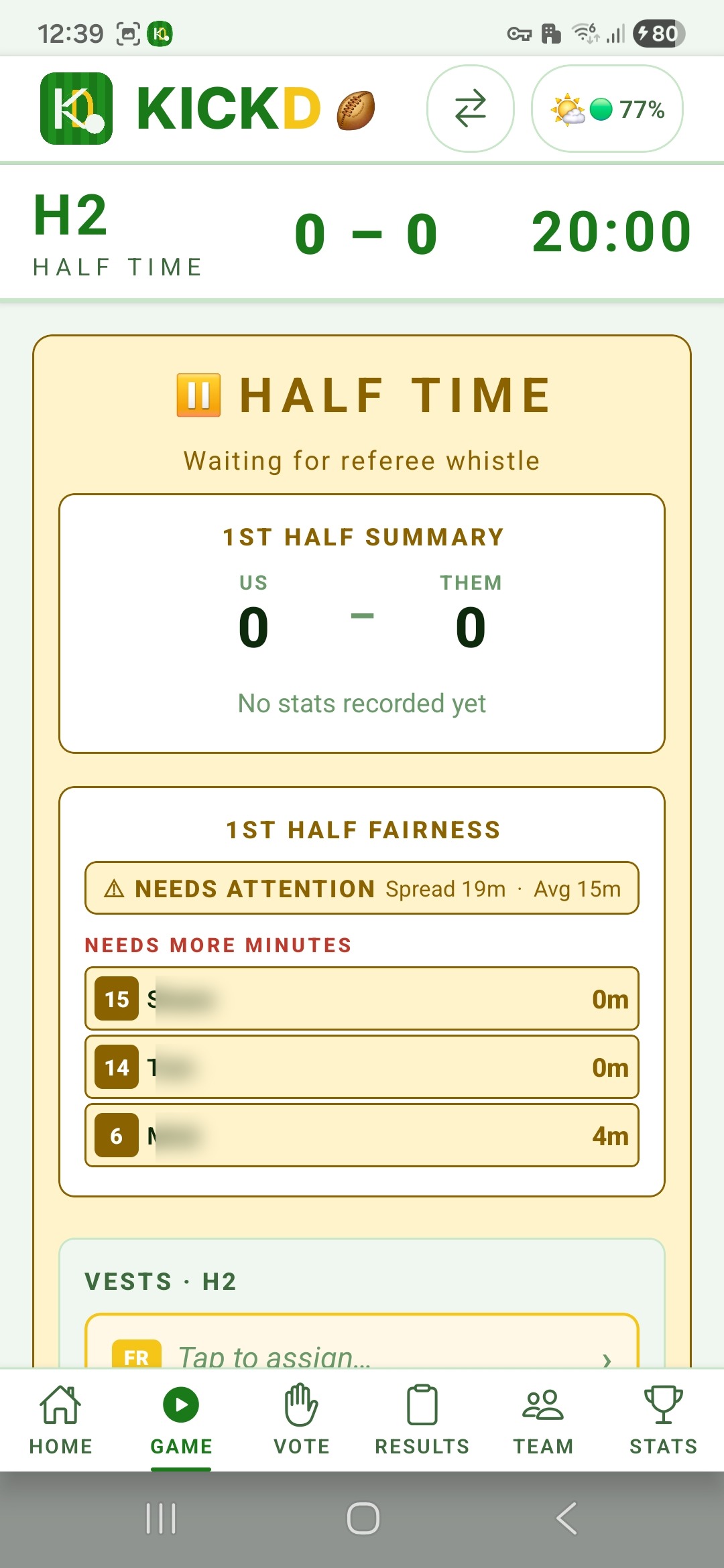
Every player's minutes, tracked automatically — so no one gets left on the bench.
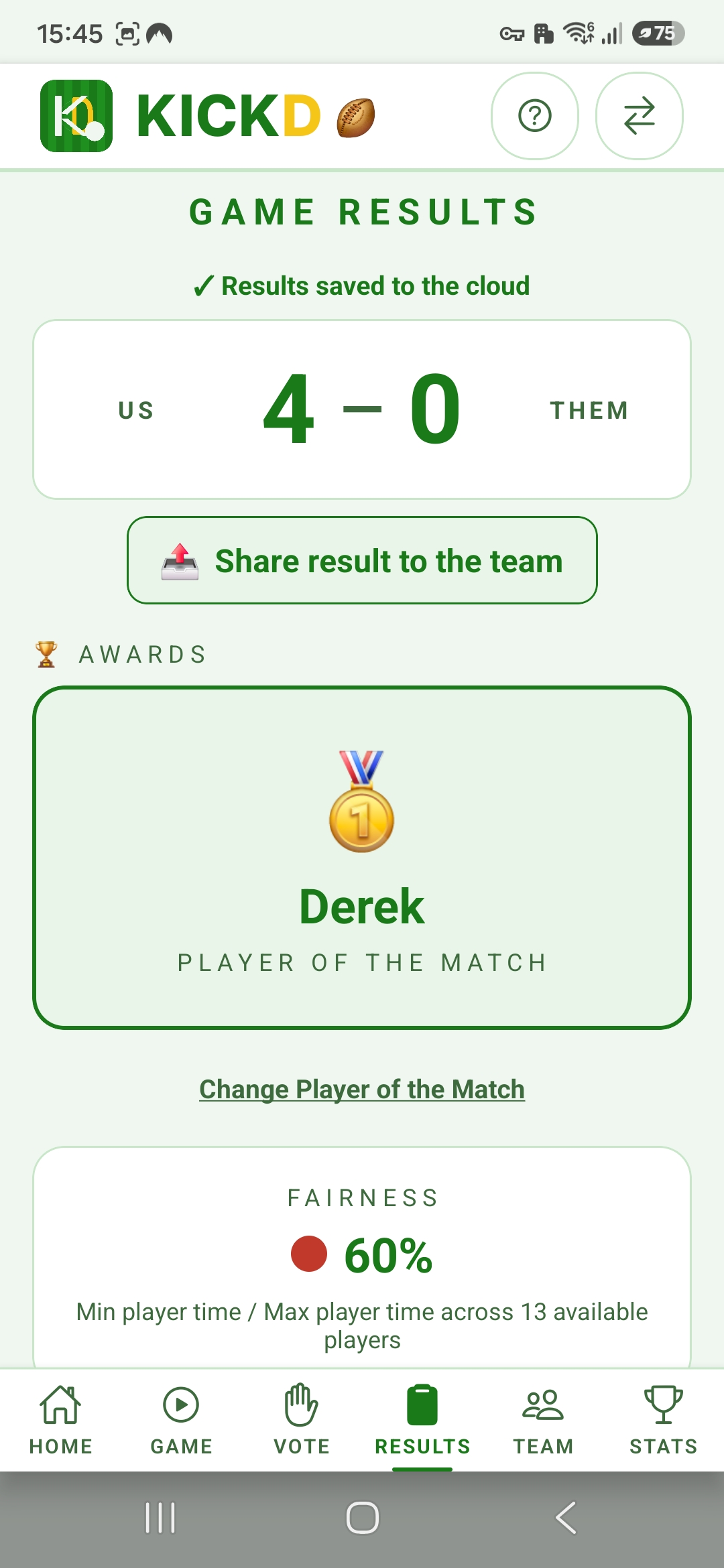
Kickd tracks every player's time on the field automatically with a wall-clock timer — no manual stopwatch. At every quarter and half break, and at full-time, the coach gets a Fairness summary: the spread between the most- and least-played players, the team average, a “Needs Attention” flag, and a “Needs More Minutes” list telling you exactly who to get back on next period.
Every kid gets a fair go — tracked automatically, not on a notepad.
The fairness percentage shows for U6–U11. U12 keeps per-player counts but eases off the season-fairness framing for the slightly more competitive age group.
The new First Receiver & Dummy Half vest laws — made invisible.
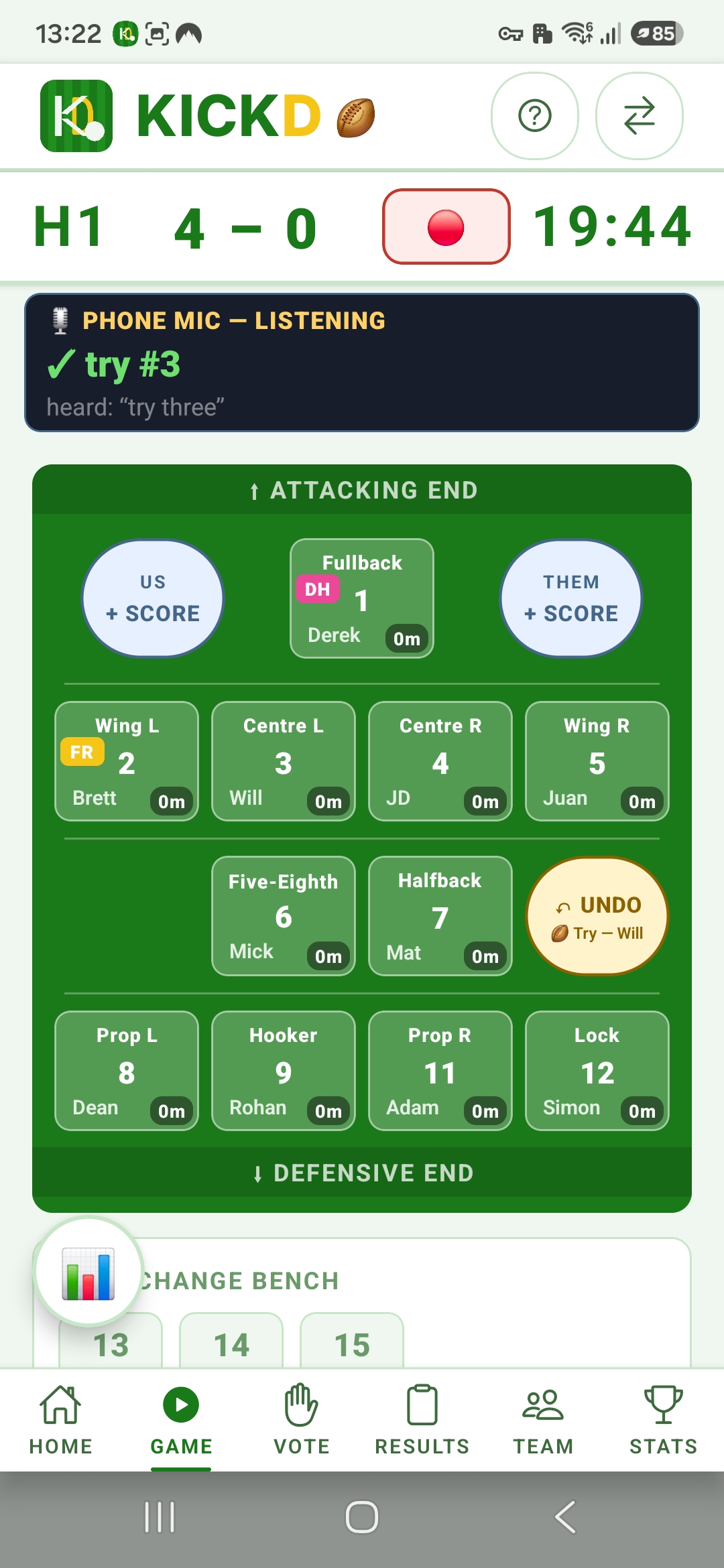
The 2026 laws introduce two rotating vested roles — First Receiver (yellow vest) and Dummy Half (pink vest). They're roles, not positions: they force the acting-half and first-receiver jobs to be shared rather than monopolised by one or two confident kids. (U8 = First Receiver only; U9–U12 = both. U6/U7 have none.)
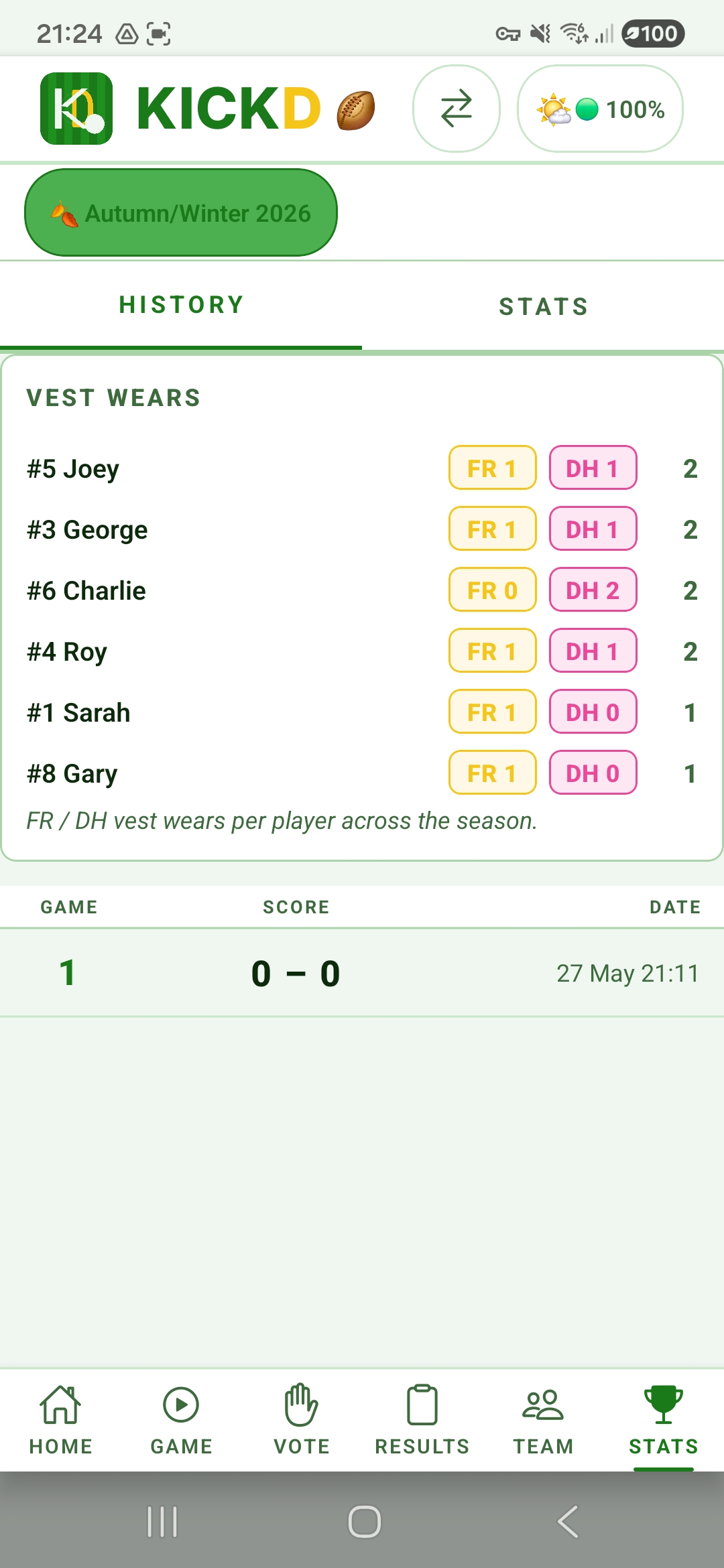
Kickd enforces the two hard rules so you don't have to: a vest is worn for a whole period (quarter for U8/U9, half for U10–U12), and one wear per player per match — wear it once, and someone else takes it next period. If a vested player is subbed off or unavailable, a yellow reminder banner appears with a one-tap replacement picker. A Vest Wears card on the season Stats screen proves every kid got a fair turn in both roles.
The new vest laws are confusing. Kickd makes them invisible — it just works, and keeps you compliant.
The right format for every age group — handled for you.
Kickd already knows the format for each age group, so you don't set it up from scratch:
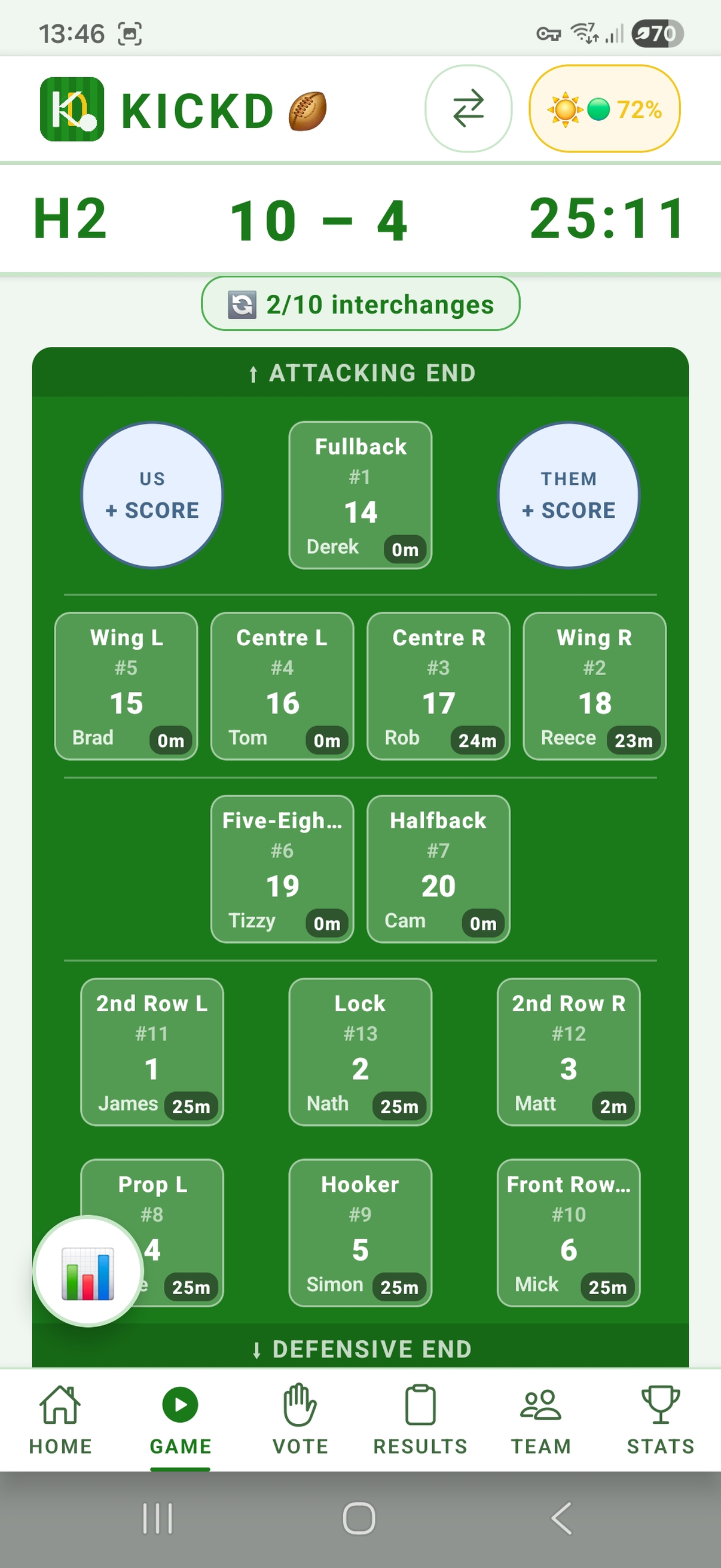
Formats are coach-selectable where leagues differ (quarters vs halves, 15 vs 20 min halves). A rotation timer (U6–U9) reminds you when to swap so everyone rotates fairly — and vested players are automatically excluded from rotation, because the law says they play the whole period. From U10–U12 you can pre-plan interchanges by minute and Kickd alerts you at the right moment — and because the laws give every U10–U12 player one unbroken half, the half-time card names who is still owed theirs while you can still give it to them.
Give the whole team community a voice — from their own phone.
Parents and players follow the game live — score and goal notifications, no chasing the coach. Coaches share a single Join Code / QR; everyone taps and they're in. No accounts to chase, no setup night.
Turn on Player of the Match and the whole sideline votes anonymously. Anti-bias rules are built in — no self-votes, and the coach's vote counts double — so the award stays fair and stays earned.
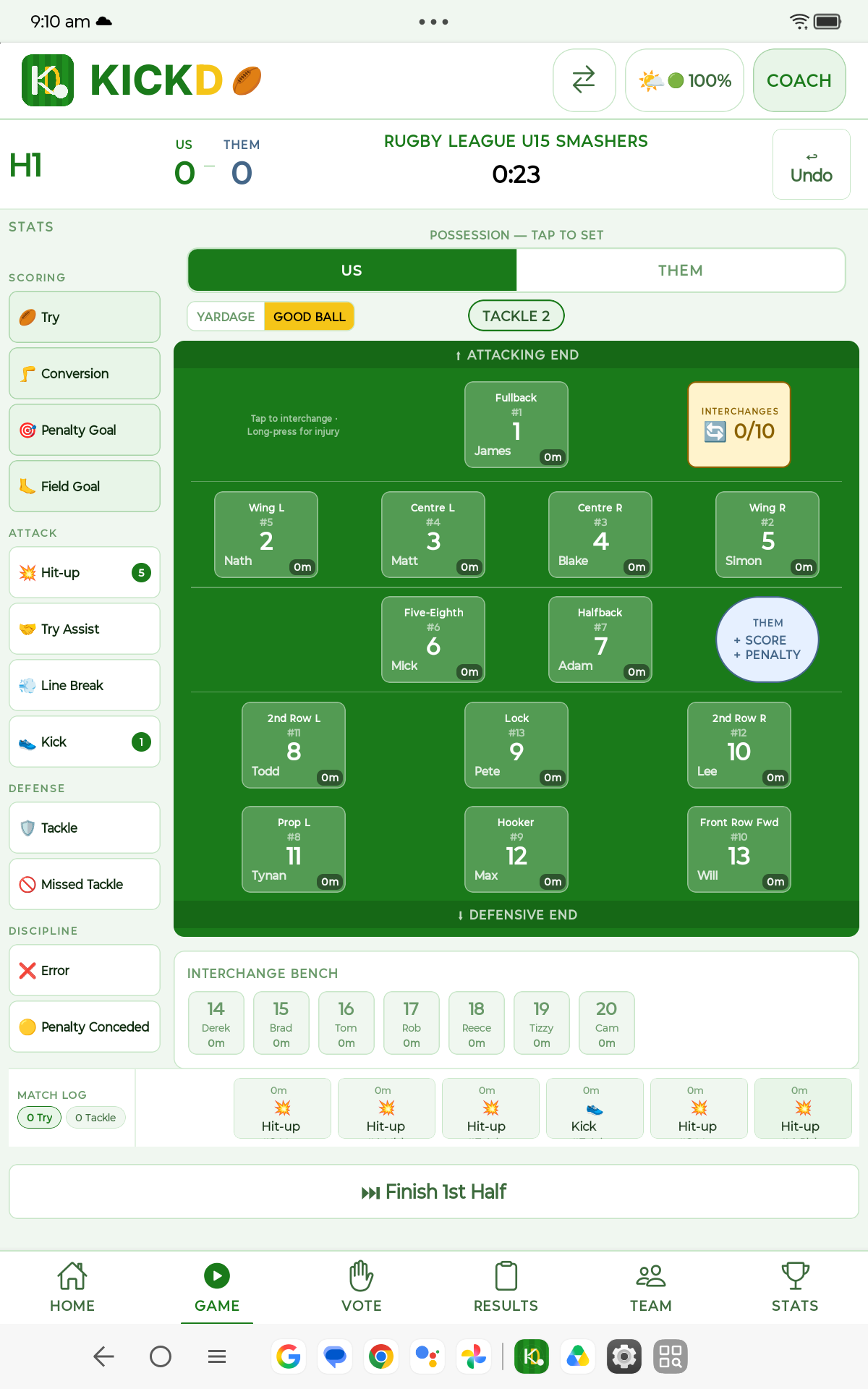
One app, the whole journey
A coach who starts at Under 6 keeps the same app all the way to Opens — fairness and vests when the kids are little, advanced analytics when they grow up.
A consistent standard across every coach
Whether it is a first-season volunteer or a 20-year veteran, every coach runs the same fair, compliant, data-backed game day — so good coaching habits become the default across the whole club, not a matter of luck.
Zero hardware, zero GPS
Every stat is coach-tapped on a phone or tablet. Nothing to wear, nothing to charge, nothing to lose.
Built for real sideline reality
Game Day Mode keeps the screen full-bright and awake, auto-pause handles the app being backgrounded mid-game, and undo rebuilds possession, tackle count and sets correctly.
Built in Australia, for Australian junior sport
Designed with rugby league coaches on real sidelines — from the 2026 NRL Junior Laws to senior match analytics — not adapted from an overseas template.
Pre-loaded for gifted clubs
If a club gifts a subscription, team setup — name, age group, sport, players — is pre-loaded. Coaches just check and go.
Play 9s as well? Rugby League 9s is in Kickd: 9 a side, two 9-minute halves, sets of four and unlimited interchange, with the conversion asked the moment the try goes down.
See 9s in Kickd →Rugby league questions, answered
Kickd is an Australian sports coach app built for rugby league: coaches plan and track interchanges live, juniors get fair game-time and NRL Junior Laws compliance automatically, senior grades get the possession, tackle-count and set-completion analytics top teams run, and the match clock keeps running while the app is backgrounded (with a live lock-screen timer) — from Under 6 to Opens.
How does Kickd manage rugby league interchanges?
Coaches plan interchanges before kickoff — minute, player off, player on — and Kickd alerts them live when each one is due. The interchange counter tracks the 10-a-match limit (8 at Opens) and warns when you go over, without ever blocking a sub. For U6–U9, a rotation timer shares game time automatically instead.
Does the match timer keep running if I leave the app?
Yes. The match clock is anchored to real time, so backgrounding the app, locking the phone or stepping away for photos never stops it — the time is right when you come back, and a live match timer sits on your lock screen on both iPhone and Android.
Does Kickd support the NRL Junior Laws and vest rules?
Yes. For U8–U12, Kickd tracks the First Receiver and Dummy Half vests each period, warns when a vest hasn't rotated, and reports season-long vest fairness per player — alongside automatic fair game-time tracking for every junior age group.
What rugby league stats does Kickd track?
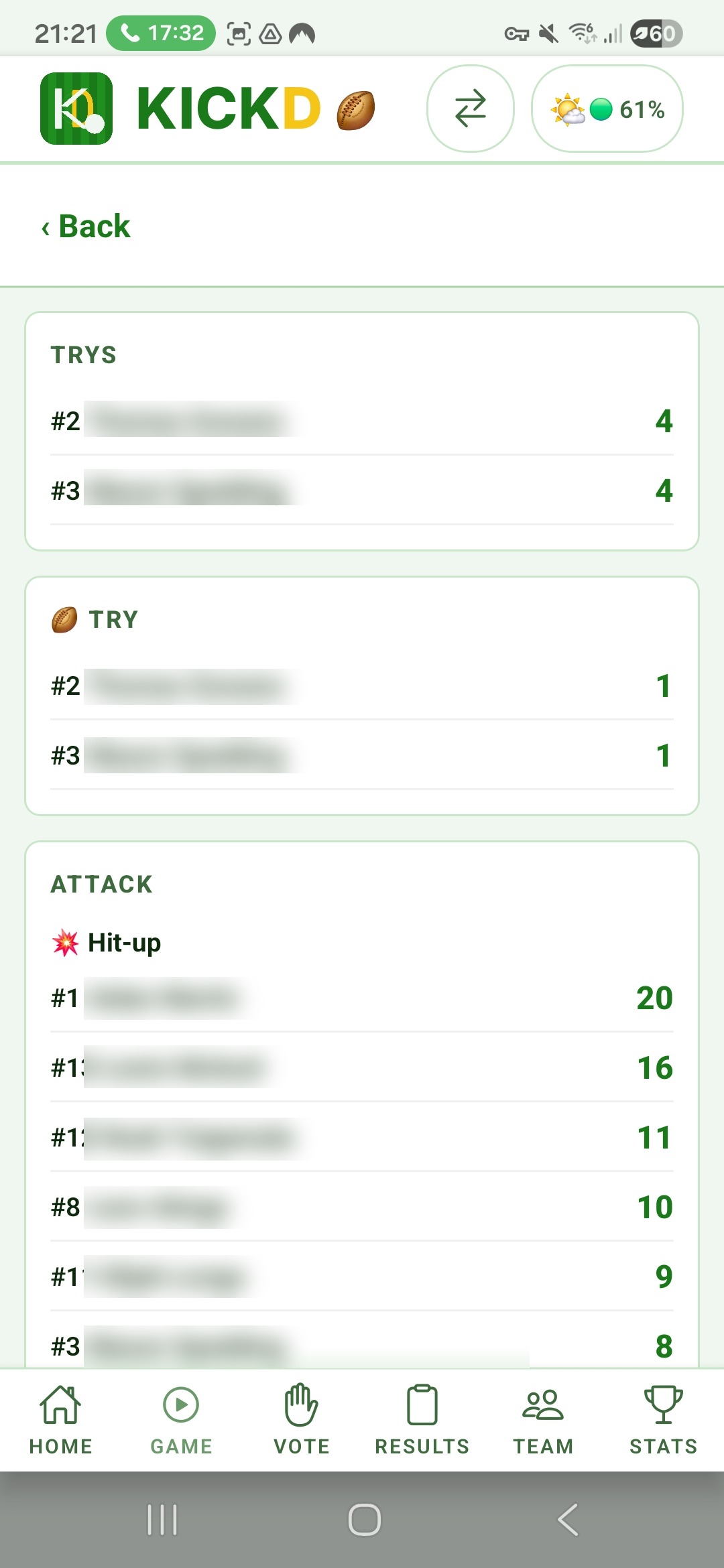
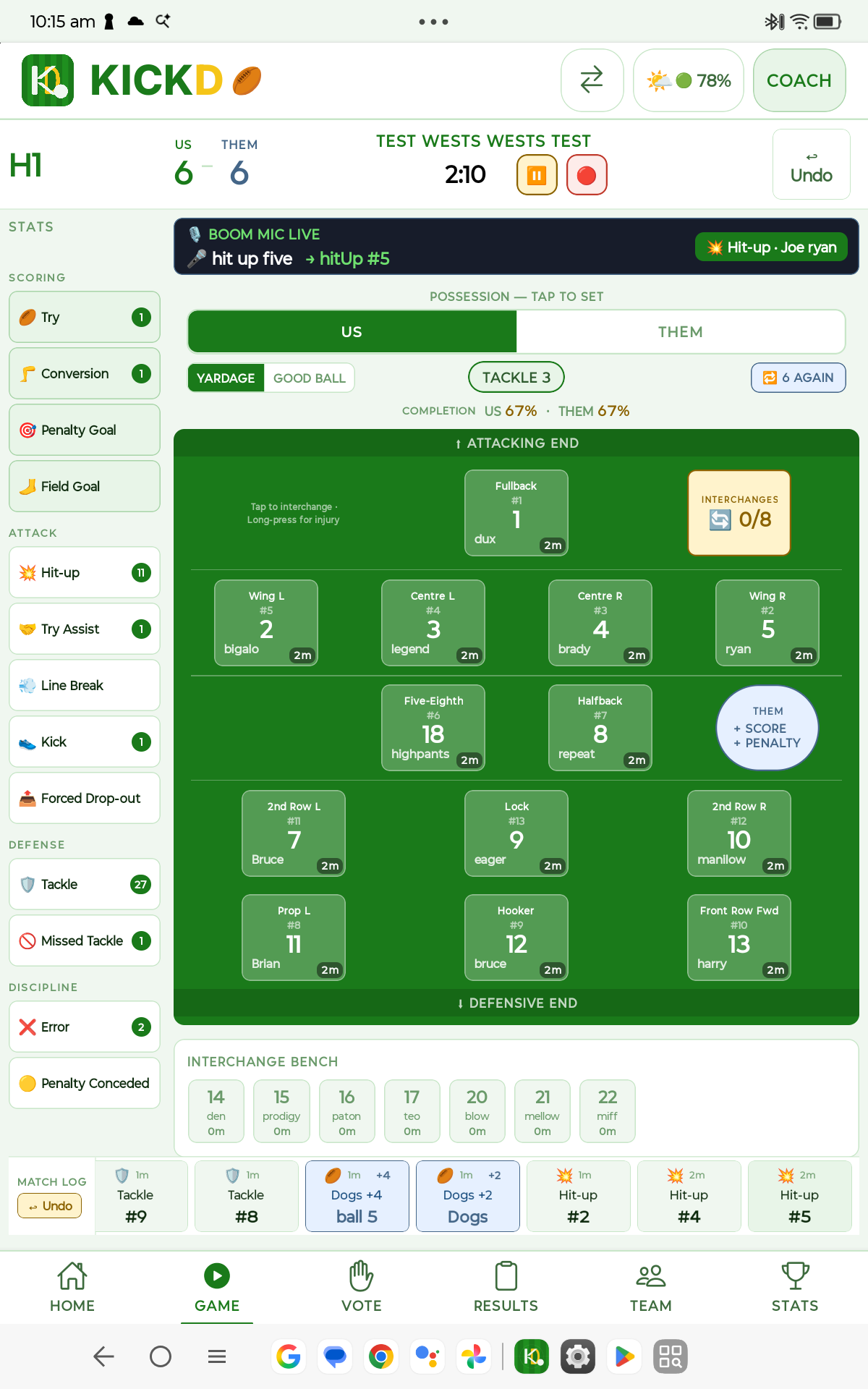
Scoring: tries, conversions (made and missed), penalty goals and field goals at every age. From U13 up with Team Stats (or U10 to U12 with the EXTENDED STATS toggle, built for rep-pathway sides), every team starts on the Set Completion level: scores, kicks, errors, penalties and handovers for both teams, which is all completion % needs, with live possession and a set-by-set breakdown at half time. Full logging, one tap under LOGGING LEVEL on the TEAM tab, adds hit-ups, unloads, tackles, missed tackles, line breaks, try assists, 40/20s, forced drop-outs, held-up-in-goal, six agains both ways, error types, on report, the live tackle count and the good ball vs yardage split. Switch either way at any time, even mid-match. Sin bin and sent off are logged from U13, the ages the laws allow them (the extended-stats toggle does not add them for juniors), and HIA from U10; the sin-bin countdown starts when the player leaves the field, and both it and the HIA countdown run on the game clock.
Does Kickd work for senior and Opens rugby league?
Yes. Senior grades get full 13-a-side positions, planned interchanges with the 8-interchange Opens cap, the advanced match analytics with Team Stats, and season awards by coach-entered 3-2-1 ballots or player voting. Every player sees their own stats the moment the game ends.
How much game time do juniors get with Kickd?
Kickd tracks every player's minutes automatically and shows the coach exactly who is owed time next, so equal participation is backed by live data rather than a notepad — and rolls up across the season for the club to see.
Can I log rugby league by voice?
Yes — Kickd Callout, included in every plan at every age group, logs the whole match completely hands-free on your phone mic or a Bluetooth headset (a boom mic like the Shokz OpenComm 2 is what holds up in sideline noise): say "hit up seven" or "try four" and the possession, tackle count and stats update without touching the screen. Recognition runs on-device and works fully offline.
How do I track set completion rates in rugby league?
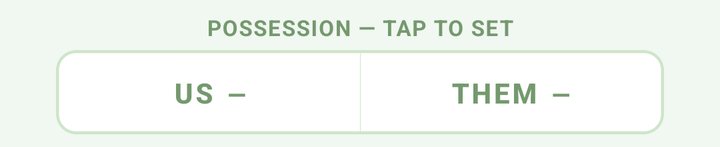
Call how every set ended, both teams. At kick-off tap US or THEM on the possession banner, then each time a set ends tap what ended it: a score, a kick, a handover, an error or a penalty. Scores, kicks and handovers count as completed, errors and penalties as incomplete, possession flips for you, and completion % for US and THEM updates live and sits on the half-time card with a set-by-set breakdown. That is the Set Completion level every new team starts on, five taps a set and one person can do it. Full logging adds hit-ups advancing the tackle count and the yardage vs good-ball split. Log by tap, or hands-free by voice with Kickd Callout. Proven at first grade: almost 350 sets and over 3,000 match events logged across seven rounds by one person.
Where should a new rugby league coach start with Kickd?
Kickd teaches rugby league in levels of logging, and the first three each have their own tutorial video on the rugby league page. Level 1, game day basics: scores, interchanges or rotations, and the vests at U8 to U12. For Under 12s and younger that is the whole job (tutorial: youtu.be/JAupV1CFT_U). Level 2, Set Completion: from Under 13 every team starts here, logging how each set ended for both teams, which gives completion % from the first game (tutorial: youtu.be/rsL5FpnznvE). Level 3, Full logging: hit-ups, tackles, Good Ball or Yardage and every player stat, for when the Set Completion calls come easily (tutorial: youtu.be/SSqs5IDuqaM). Levels 2 and 3 come with Team Stats, and you switch between them with one tap under LOGGING LEVEL on the TEAM tab. Level 4 is Club Pro, a club subscription that adds a second logger for the opposition and play-the-ball speed (kickd.au/club-pro).
Do I have to log every hit-up and tackle to get completion % in rugby league?
No. On the Set Completion level you log only how each set ended (a score, kick, handover, error or penalty, for both teams) and Kickd counts every set and gives you completion % from your first game. Hit-ups, tackles, line breaks and the Good Ball call are the Full level, one tap under LOGGING LEVEL on the TEAM tab, and you can switch either way at any time. After three games with every set logged, the results screen offers the switch to Full; it never switches by itself.
Does Kickd help with the U10 to U12 unbroken-half rule?
Yes. The 2026 junior laws say every U10 to U12 player must play at least one unbroken half, and a player who has done theirs can only replace someone who has too. Kickd warns rather than blocks: the half-time card lists who is still owed their unbroken half while you can still give it to them, and who is on track and needs to be left on — worked out from the live subs, so an undone interchange corrects it straight away.
How many players are on the field in junior rugby league?
It grows with the age group under the national junior formats: 6-a-side at U6 and U7, 8-a-side at U8 and U9, 11-a-side at U10 and U11 and the full thirteen from U12. Kickd's field view follows the same ladder, with named positions from U10 and numbered rotation slots before that.
How long is a junior rugby league game?
U6 to U9 play four 8-minute quarters. U10 to U12 play two halves, 20 minutes by default in Kickd with a 15-minute option for Mod League comps. U13 to U15 play 25-minute halves (30 as an option), U16 to U18 30 (35 as an option) and Opens 40. Associations vary, so set yours on the TEAM tab; the live timer counts down each period on your lock screen.
What does Kickd cost for rugby league?
Your first 3 matches are free at the full Team Stats level, so you see everything before paying anything. After that a Team Pass is $19.99 per team, per season: the live match clock, substitutions and rotations, fair game time, lineups, tries, conversions, penalty goals and field goals with the scorer attributed, sin bin and sent off from U13, and HIA from U10, Player of the Match and the free parent live view — all of it callable by voice with Kickd Callout. Team Stats is $49.99 per team, per season and adds the full rugby league stat set — hit-ups, tackles, line breaks, errors, kicks, 40/20s, on report, live possession, the tackle count and set completion split good ball vs yardage, from U13 or with the U10 to U12 EXTENDED STATS toggle — and widens what Callout hears to match; a coach on a Team Pass can try it free for 14 days, once. A Performance Analyst logging for a Team Stats team gets the full set with no pass of their own. Parents and supporters are always free, and a club buys one plan that covers every team, priced per sport on the pricing page.
Read more
Ready to run rugby league game day with Kickd?
Download the app and run your first 3 matches free at the full Team Stats level, or set up every team in your club at once.